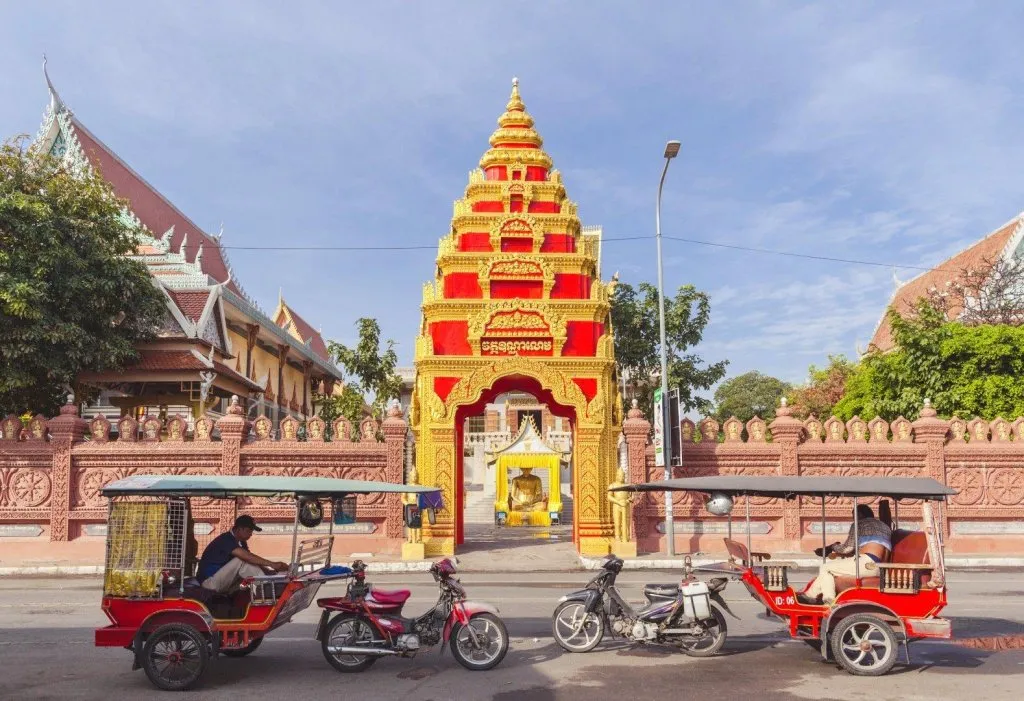
金边王宫 (Royal Palace of Cambodia)是柬埔寨国王的宫殿,由一组金色屋顶、黄墙环绕的建筑组成,造型精美,金碧辉煌,充满高棉传统建筑风格。
文化古迹
建议游玩时间: 2-3小时
分享此页面
评价
(20 评价)来源:Google
Cala Leila
English
·
Beautifully presented palace and grounds. A few things prohibited access but there is a public holiday this weekend so may be to do with that. The grounds were lovely and quiet at around 10am on Tuesday. Can pay with cash or ABA. Cash preferred I think - $10 a person.
Sara
English
·
I visited just past 2:00pm on a weekday, as it said Google that the Palace is closed from 11am-2pm, and there were maybe only a dozen people total on the Palace grounds. Ahead of the ticket booth, I was greeted by a friendly tour guide. The ticket entry is $10 and the tour guide is another $10, both paid to the ticket booth. I appreciated having a tour guide and would not have been able to appreciate everything as much without one. The tour was pretty fast, mayne 30 minutes, then the guide leaves you towards the exit with the option to continue to walk around on your own.
Jacob Tharakan Chacko
English
·
The Royal Palace of Phnom Penh is Cambodia’s most striking symbol of monarchy, religion and Khmer culture.
The present palace complex dates back to 1866, when King Norodom moved the capital to Phnom Penh. It was built during a period when Cambodia was increasingly coming under French influence. The palace remains the official residence of the Cambodian monarch, and much of the complex is not open to the public. Only two quarters are open to tourists.
The architecture is unmistakably Khmer. Its soaring roofs, gilded finials and ornate decorations reflect a long tradition in which the royal palace was regarded as a meeting place between the earthly world and the sacred realm. At the heart of the complex is the Throne Hall, where coronations, royal ceremonies and important state occasions take place. Its tall central tower rises above the surrounding buildings, giving the palace its distinctive silhouette. Nearby is the Chan Chhaya Pavilion, traditionally associated with royal dance and ceremonial performances.
Perhaps the most fascinating part of the complex is Wat Preah Keo Morakot — the Silver Pagoda. Unlike an ordinary Buddhist monastery, it is a royal place of worship and has no resident monks. Its popular name comes from the 5,329 silver tiles covering its floor. The pagoda houses an extraordinary collection of Buddhist objects, including the famous Buddha figures made of precious metals and decorated with gemstones.
There is an interesting layer of traditional belief surrounding the palace. Cambodian tradition has long associated kingship with a sacred relationship between the ruler, the land and the heavens. The location of the royal complex was traditionally regarded as important from an astrological and geographical perspective, with the king's position being seen as connected to cosmic order.
The Silver Pagoda itself is considered a place of particular spiritual importance. Devotees traditionally come to pray for peace, prosperity and happiness, while the sacred images and relics within it are regarded with deep reverence.
Another striking feature is the mural surrounding the Silver Pagoda, depicting episodes from the Ramayana, known in Cambodia as the Reamker. This is a reminder of how Hindu epic traditions became woven into Khmer culture and later coexisted with the country's dominant Buddhist tradition.
There is also a commonly held belief that the palace's grandeur is not simply an expression of royal wealth. Its architecture, elevation, symbolism and ceremonial spaces collectively represent the sacred status of the Cambodian monarchy and the connection between earthly kingship and the divine order. This is a cultural belief rather than something that can be established as historical fact, but it helps explain why the palace is regarded with such reverence.
Walking through the Royal Palace today, therefore, is not simply a visit to an architectural monument. It is a glimpse into the intersection of Cambodia's monarchy, Buddhism, ancient Khmer traditions and living cultural beliefs.
Animus Peregrinans
English
·
Amazingly beautiful buildings over quite a large area. We went without a guide and just marveled at the beauty of the architecture. Remember to dress respectfully (long pants and covered shoulders). Also, it gets very hot walking around, as there is not much shade in parts, so wear a hat and sunscreen. It gets busy - best to pay attention to the opening hours and get there just as it opens. So many buildings, gardens, statues, etc. We spent a couple of hours here.
유레아
한국어
·
24년 10월달 방문!!
볼거리는 짧지만 입장료 아깝지 않은 구경거리였어요. 웅장하고 금빛으로 물든 인테리어들이 꽤 인상적이면서 한국에는 없는 매력적인 요소들이 많았어요. 앞으로 캄보디아 갈일은 없겠지만 왕궁은 생각 날 것같아요